All you need to know about cardiac rehab

Featured image for All you need to know about cardiac rehab

All you need to know about cardiac rehab

If you have had a heart attack or heart surgery, cardiac rehab usually starts when a member of the team visits you on the ward before you go home. This is an opportunity to talk about your condition, the treatment you've had and your recovery.

Cardiac rehab gives you and your family the information, support and advice you need to return to everyday life. Cardiac rehab is a vital part of your long term recovery, so consider it as important as taking your medication. Research has shown that cardiac rehab can reduce your risk of having another heart event, being readmitted to hospital and has a positive impact on your wellbeing and quality of life.

It is an individualised programme usually made up of a mix of exercise and education sessions. You may also be able to access it through other formats such as the Heart Manual or through other resources if you are unable to attend in person, or if you would rather do a home based programme.

Attending cardiac rehab will help you live a heart healthy lifestyle and provide psychological support for the anxiety and depression often associated with a heart event, or living with a heart condition.

Many cardiac rehab centres run two sessions a week, but this varies from place to place. Cardiac rehab may take place in a hospital or community setting such as a leisure centre. It isn’t a residential programme.

How can cardiac rehab help me?

Cardiac rehab will help you with:

  • understanding your condition
  • recovering from your surgery, procedure or heart attack
  • making changes to your lifestyle that will help improve your heart health
  • reducing the risk of further heart problems
  • the psychological aspects of living with a heart condition.

People are often nervous about starting cardiac rehab as they worry about not being able to do as much as other people or being the odd one out, but everyone has ‘first day nerves’ and you are quickly put at ease.

You will be offered an initial assessment, where you and a cardiac rehab specialist will discuss an individualised plan for you.

Cardiac rehab also gives you the chance to meet other people who are going through similar experiences as you and helps you build up your confidence.

No matter your age, gender or ethnicity you will benefit from cardiac rehab.

If you have reduced mobility, are hard of hearing or visually impaired, speak to your cardiac rehab specialist and they will be able to adjusted the programme to suit your needs.

If English isn’t your first language, and you do not have a family member able to attend with you, it may be possible for the team to arrange for a translator to be present.

Cardiac rehab programmes last for up to 10-12 weeks and the sessions usually run for approximately 2 hours at a time. If you can, make time for cardiac rehab, and prioritise it like you would a hospital appointment.

Cardiac rehab classes usually take place on weekdays between 9-5, so you may have to take time off work to attend. Discuss with your colleagues that in the short term attending will help with your long term recovery.

When will I start cardiac rehabilitation?

If you have had a heart attack or heart surgery, cardiac rehab usually starts when a member of the team visits you on the ward before you go home. This is an opportunity to talk about your condition, the treatment you’ve had and your recovery.

After leaving hospital, a cardiac rehab nurse will ring you, or you can call them if you have queries or questions. Their phone line will be open Monday to Friday and if you need to leave a message they will get back to you as soon as they can.

If your procedure doesn’t involve staying in hospital for longer than a day, such as after having a stent, speak to your GP or nurse about being referred to a cardiac rehab programme. Depending on your condition and your recovery, you should also be invited to start a cardiac rehabilitation programme as soon as a place becomes available for you and you feel ready to start.

You will be invited for an assessment prior to attending the first session. If you’re apprehensive about cardiac rehab, going along to this initial assessment will help put your mind at ease and you will be able to chat to the specialist nurse or physiotherapist about your worries.

This is an opportunity to discuss ways of addressing your risk factors such as eating more healthily, giving up smoking as well as how you can safely build up your exercise levels. This may also be the time to talk about personal concerns such as sexual problems and financial issues. The nurses are very used to hearing about these problems and have the time to listen and advise.

Who is offered cardiac rehab?

Cardiac rehab is available to people who have had:

If your doctor or nurse recommends that you don’t need cardiac rehab but you feel you would benefit from it, don’t be afraid to express this to them. Ask them to refer you as patients can’t attend a programme otherwise.

What happens at cardiac rehab?

Exercise sessions

A group cardiac rehab programme should include around 10-12 weeks of structured exercise sessions tailored to each person’s individual need, allowing them to safely return to fitness and gradually build in strength and confidence.

A typical exercise session involves a warm up, the main exercise component, which may be circuit based or use equipment such as stationary bikes, and a cool down. Some programmes have a relaxation session at the end too.

  • The warm up prepares your heart for exercise by slightly increasing your heart rate, this will make you slightly breathless and prepare your body and muscles to reduce the risk of injury.
  • The main exercise component involves working at an intensity so that you feel like you are benefitting from the exercise and are slightly out of breath, but that you can still hold a conversation. The team will come round and talk to you to see how you are getting on and they will check your pulse to see if you are meeting your target heart rate.
  • The cool down gradually brings your heart rate and breathing back down to what it was when you started.

Don’t worry if you feel nervous about exercising. The nurses, physiotherapists and exercise specialists will be on hand to support you and ensure you exercise safely and effectively to ensure you get the best out of your sessions. You will be able to exercise at a pace that feels right for you, so don’t worry about keeping up with others or feeling too restricted if you feel you could push yourself further.

You could also try our target heart rate calculator which will help you work out the heart rate you should be aiming for while exercising.

The type of activity you do during the exercise component can depend on your fitness level before your heart event or diagnosis. If you were very active before, you may find you are able to do more at your sessions than others, but it is still important to return to it gradually.

Learn more about what happens at cardiac rehab by reading an instructor’s account of a typical exercise session.

People often ask whether there is a dress code at cardiac rehab – there isn’t, but your safety is paramount. It’s recommended you wear something cool and comfortable that you can easily move around in, like tracksuit bottoms or shorts and a t-shirt, and closed-toe, non-slip shoes or trainers.

Information and education sessions

Alongside your exercise session, you may also have group education sessions. These sessions usually cover a variety of topics such as eating healthily, how to exercise safely, stress management, how to perform basic life support (CPR) and medication for the heart.

If you have questions, these sessions are the perfect place to ask them. Your family members are also welcome to come along and ask questions too, but they won’t be able to participate in the exercise component.

Emotional support and wellbeing

After a heart event, it is normal to feel a mixture of emotions, like anger, frustration and feeling sad. Feeling confused and isolated after a heart event is very common and can have a major effect on you and your loved ones.

Visit our health and emotional support page for advice and information about adjusting to life with a heart condition and dealing with mental health concerns or stress.

Frequently Asked Questions

What does it cost to attend a cardiac rehab programme?

A cardiac rehab programme offered by a hospital is free of charge. Exercise sessions which you might do as an ongoing programme may have a small cost attached, but you will continue to be monitored by specially trained exercise advisors.

There are some Heart Support Groups that organise cheaper exercise classes.

Where’s my nearest cardiac rehab programme?

You can find out where your nearest cardiac rehabilitation programme is by visiting cardiac-rehabilitation.net or by calling our Heart Helpline on 0300 330 3311.

What if I can’t attend a cardiac rehab programme?

You may find that your condition or circumstances make it difficult for you to attend a cardiac rehabilitation programme. If so, talk to the cardiac rehabilitation team about other ways you can benefit from the programme – for example you may be able to follow a programme in your own home with support from your local cardiac rehabilitation team.

More information on cardiac rehabilitation

For more information on cardiac rehab and the support available to you:

Content provided by the British Heart Foundation.

Our vision is a world free from the fear of heart and circulatory diseases. We raise money to research cures and treatments, so we can beat heartbreak forever.

Published on Fri, 10 Dec 2021 10:40:05 GMT
Modified on Mon, 13 Dec 2021 10:45:51 GMT

Bowel Screening

Featured image for Bowel Screening

Bowel Screening

NHS bowel cancer screening checks if you could have bowel cancer. It's available to everyone aged 60 or over and 56 year olds and regular screening reduces the risk of dying from bowel cancer by helping to find it at an earlier stage. Learn more about the screening process and how to use your FIT kit.

Why we offer bowel cancer screening

We offer screening to detect bowel cancer when it is at an early stage in people with no symptoms. This is when treatment is more likely to be effective. Screening can also find polyps. These are abnormal clumps of cells in the bowel. Polyps are not cancers, but may develop into cancers over time. Polyps can be easily removed, which reduces the risk of bowel cancer developing.

Regular bowel cancer screening reduces the risk of dying from bowel cancer.

Who we invite

We offer bowel cancer screening using a home testing kit to everyone in England from the age of 60.

Your GP practice gives us your contact details so please make sure they always have:

  • your correct name
  • date of birth
  • address

Many GPs also like to have your mobile number and email address.

We offer screening every 2 years between the ages of 60 and 74. We are gradually extending this age range, and people aged 56 are now being invited as part of this process.

If you are over 74, you can ask for a kit every 2 years by calling our free helpline on 0800 707 60 60.

You may be asked to take part in a research project (a ‘clinical trial’). Research helps the NHS improve bowel cancer prevention and treatment for people in the future. You can choose whether to take part or not. Your choice will not affect your bowel cancer screening.

Bowel cancer

Bowel cancer is also known as colon, rectal or colorectal cancer. Sometimes the cells that make up the bowel grow too quickly and form a clump of cells known as a bowel polyp (some types of polyp are called an ‘adenoma’). Polyps are not bowel cancers but they can sometimes change into a cancer over a number of years.

Risks of developing bowel cancer

Everyone, whatever your sex, is at risk of developing bowel cancer. Things that can increase your risk include:

  • getting older (8 out of 10 people diagnosed with bowel cancer are over 60)
  • not being active enough
  • being overweight
  • a diet high in red and processed meat and low in fibre, vegetables and fruits
  • smoking
  • drinking too much alcohol
  • having type 2 diabetes
  • having inflammatory bowel disease (ulcerative colitis or Crohn’s disease)
  • a family history of bowel cancer

Reducing your risk of bowel cancer

Having bowel cancer screening reduces your risk of dying from bowel cancer by at least 25%.

You can also reduce your risk of bowel cancer by:

  • keeping physically active
  • keeping a healthy weight
  • eating plenty of fibre – for example, choose wholegrain and wholemeal foods
  • eating plenty of vegetables and fruit
  • eating less red meat and especially less processed meat
  • drinking less alcohol
  • not smoking

How bowel cancer screening works

We send you an invitation letter with information about bowel cancer screening. The information is to help you decide whether to take part. Then we send you a faecal immunochemical test, or ‘FIT kit’ for short. It detects blood in your poo (blood you would not notice by eye). We look for blood because polyps and bowel cancers sometimes bleed. Finding blood does not diagnose bowel cancer but it means you need further tests (usually a bowel examination).

Most people’s screening result shows they do not need any further tests.

Some people will need further tests. If this is the case for you, we will offer you an appointment to talk about having a colonoscopy. Colonoscopy looks at the inside of your bowel. We use colonoscopy to find the source of the blood.

Using the FIT kit

Using-the-FIT-kit

Video – Using your bowel cancer screening kit

A short animation that shows you how to use the FIT kit.

The animation is available with subtitles and in British Sign Language.

Subtitled versions are provided in English, Arabic, Bengali, Chinese (simplified and traditional), Farsi, Gujarati, Polish, Portuguese, Punjabi and Urdu.

You use the FIT kit in the privacy of your home. It’s a simple way to collect a tiny sample of poo. The kit is a small plastic bottle with a stick attached inside the lid. You use the stick to collect the sample, which you seal into the bottle. There are instructions with each kit.

Once used, you post the kit in its prepaid packaging to a laboratory for processing. Using the kit takes just a few minutes and it’s an easy and effective way to screen for early bowel cancer.

If you’re not sure whether you should use the kit, please call our free helpline on 0800 707 60 60 for advice. For example, if you have had surgery and have an artificial opening that allows poo from the bowel to pass (a stoma) then you might want to call us.

No screening test is completely effective. In bowel cancer screening this is because:

  • a polyp or cancer can sometimes be missed if it was not bleeding when the screening test was taken (a ‘false negative’ result)
  • bowel cancer may develop in between screening tests

Results

You should receive a results letter within 2 weeks of sending in your sample. There are 2 possible results.

No further tests needed at this time

Most people (about 98 out of 100) have this result. It means that we did not find any blood in your sample, or only a tiny amount which is within the screening range.

This result does not guarantee that you do not have bowel cancer, or that it will never develop in the future. We will offer you bowel cancer screening again in 2 years’ time if you are under the age of 75.

Further tests needed

About 2 in every 100 people have this result. It means that we found an amount of blood in your sample above the screening range.

This does not mean that you have cancer, but it does mean we will offer you an appointment to discuss having a colonoscopy. Several things can cause blood in poo, such as:

  • haemorrhoids (piles)
  • bowel polyps
  • bowel cancer

Having further tests (usually a colonoscopy) means we can look for the cause of the blood.

If you need further tests:

We will offer you an appointment at a local screening centre (usually in a hospital). This is to discuss having a more detailed examination of your bowel (colonoscopy). The colonoscopy is to see if there is a problem that needs treatment.

Only around 2 in 100 people who complete the FIT kit need a colonoscopy.

For more information, you can read the Government leaflet about colonoscopy.

Possible benefits and risks of bowel cancer screening

Benefits

  • reduces your risk of dying from bowel cancer by at least 25%
  • allows us to remove any polyps found during colonoscopy, which reduces your risk of developing bowel cancer
  • can be completed at home in private

Risks

  • cause complications, for example, during or after colonoscopy
  • miss a cancer if it was not bleeding when you used the FIT kit

Find out how to opt out of screening.

Further information:

For more information about bowel cancer screening, or if you are 75 or over and would like a FIT kit, call the free helpline on 0800 707 60 60.

You can ask for a kit every 2 years.

You can also:

If you have hearing or speech difficulties you can use the Relay UK service to contact us. Dial 18001 then 0800 707 60 60 from your textphone or the Relay UK app.

Content provided by NHS.uk

Find information and advice on health conditions, symptoms, healthy living, medicines and how to get help.

Published on Thu, 09 Dec 2021 10:22:26 GMT
Modified on Mon, 18 Jul 2022 12:23:50 GMT

Become a donor

Featured image for Become a donor

Become a donor

Every year in the UK, thousands of lives are saved thanks to the generosity of donors. Do you know where and what you can donate? Find out more and join the growing number of new donors who help save and improve the lives of countless seriously ill patients.

We help people do something extraordinary – donate blood, organs, tissues or stem cells to save someone in need

Every day thousands of people’s lives are saved or improved thanks to the generosity of donors like you. But, sadly, there are still lots of patients we can’t treat because we don’t have enough supplies. There’s an urgent need for donations. Please help, if you can.

Blood Donation

Most people can give blood if they are fit and healthy, but there are some rules for donors. Find out more about who is elligible and the process of donating blood.

View more

Organ Donation

Organ donation is the act of giving an organ to save or improve the life of someone who needs a transplant.

View more

Tissue Donation

When you register to donate your organs, you can also choose to donate your tissues, including your corneas and bone.

View more

Platelet Donation

Platelets help to stop bleeding and can be a lifeline for people with cancer. Donating platelets takes just 2 hours of your time but can make a huge difference to someone's life

View more

Featured image for Blood Donation

Blood Donation

Most people can give blood if they are fit and healthy, but there are some rules for donors. Find out more about who is elligible and the process of donating blood.

Coronavirus: latest advice

Giving blood is simple and it saves lives. When you give blood, it is collected so it can be used to treat someone else.

For most people, giving blood is easy and follows the simple steps listed below. See our animation which takes you through what happens step by step.

We need more O negative and O positive donors.

Who can give blood?

Donor eligibility has changed

Most people can give blood. You can give blood if you:

  • are fit and healthy
  • weigh between 7 stone 12 lbs and 25 stone, or 50kg and 158kg
  • are aged between 17 and 66 (or 70 if you have given blood before)
  • are over 70 and have given a full blood donation in the last two years

Men can give blood every 12 weeks and women can give blood every 16 weeks.

The need for Black donors

The increased demand for some rare subtypes, such as Ro, that are more common in people of Black heritage means we need more black people to become blood donors.

Before you give blood

  1. Check you are able to give blood.
  2. Register your interest in being a donor, or call 0300 123 23 23.
  3. Sign up for an online account and find an appointment – a number of appointments can be booked in advance. If you are unable to book now, then please try for a later date. A limited number of walk-in slots are available.
  4. Follow the preparing to give blood recommendations.
  5. If you are unable to keep your donation appointment please try and give us at least 3 days’ notice. You can easily cancel or reschedule your appointment when you sign in to your online account.

Got a question about booking to give blood? Check the answers to these frequently asked questions.

When you give blood

This is what will happen when you give blood. The whole process takes about an hour.

1. Welcome and preparation

Remember to bring your completed donation safety check form with you, if you received one from us in the post. We will ask you to read our donor consent booklet (PDF 517KB) which explains the importance of blood safety. It’s important to read this whenever you attend because advice does change. We will give you 500ml of fluid just before you give blood. Drinking this over about 5 minutes will help with your well-being during and after donation.

2. Health screening

We make sure it is safe for you to donate, and that your blood donation is safe for a patient to receive.

  • We confirm your identity and ask you about the information on your donor health check form; a registered nurse may follow up if necessary.
  • We test a drop of blood from your finger to check the iron levels (haemoglobin) in your blood.

If you are not able to donate we will explain why, and may ask you to make another appointment.

If you are able to donate you will be asked to sit in a waiting area until you are called to a donation chair.

3. Your blood donation

When you are comfortable on the chair we will ask you to confirm your name, address and date of birth.

We examine your arm and place a cuff on your arm to maintain a small amount of pressure during donation (this does not measure blood pressure).

We then examine your arm to find a suitable vein and clean it with an antiseptic sponge.

  1. We will insert a needle in your arm which will collect your blood into a blood bag with your unique donor number.
  2. You should not feel any discomfort or pain. If you do, tell a member of staff.
  3. A scale weighs the blood and stops when you have donated 470ml (or just under a pint). This usually takes between 5-10 minutes.
  4. The needle will be removed and a sterile dressing applied to your arm.

More about what happens on the day when you give blood.

More about what happens after you give blood.

Content provided by NHS Blood and Transplant

We help people do something extraordinary – donate blood, organs, tissues or stem cells to save someone in need

Published on Tue, 07 Dec 2021 16:38:46 GMT
Modified on Wed, 06 Apr 2022 11:56:38 GMT

Featured image for Organ Donation

Organ Donation

Organ donation is the act of giving an organ to save or improve the life of someone who needs a transplant.

Organ donation is the act of giving an organ to save or improve the life of someone who needs a transplant.

You are able to donate some organs while you are alive, for example; a kidney, or part of your liver. However, most organ and tissue donations will come from people who have died.

Anyone can register a decision to donate their organs and tissue when they die, regardless of their age or medical conditions. To ensure that all donated organs are safe, the donor’s medical and lifestyle history is assessed at the time of donation.

Faith, beliefs and culture play a big part in how people feel about organ donation, and if you choose to be a donor, these will always be respected. Read more about organ donation and your faith

Registering your decision

Organ donation in England has changed to an opt out system. This means that all adults agree to become organ donors when they die, unless they have made it known that they do not wish to donate. You still have a choice whether or not you want to become an organ donor.

Registering your organ donation decision is important, whatever it may be, and takes just two minutes if you register online. To help you decide, get the facts.

Whatever your organ donation decision, the best thing you can do is talk with your loved ones to give them the certainty they need to support it.

What can you donate?

Everyone has a choice as to whether or not they want to become an organ donor after they die, and if you choose to donate, you can choose to donate either some or all of your organs.

By registering to become an organ donor you have the option to donate organs such as your heart, lungs, liver, kidneys, pancreas and small bowel. All of these forms of donation can greatly enhance or even save the life of someone in need.

To find out more, please click one of the links below.

Heart

Heart donation is a gift of life to those for whom standard treatments are no longer working.

Read More

Lungs

Donating your lungs after your death can mean that one or both of your lungs is transplanted to save someone’s life.

Read More

Liver

Donating your liver when you die could provide the much-needed matching organ for someone hoping for a second chance.

Read More

Kidneys

Your kidney donation could transform the life of someone dependent on daily dialysis.

Read More

Pancreas

Becoming a pancreas donor could mean providing a life-line to people who are living with advanced diabetes.

Read More

Small Bowel

Donating your small bowel when you die could provide the much-needed intestinal transplant for someone living life on a drip.

Read More

Who can donate?

The decision about whether some or all organs or tissue are suitable for transplant is always made by medical specialists at the time of donation, taking into account your medical, travel and social history.

Age limit

Is there an age limit for becoming an organ donor?

There is no age limit for becoming an organ donor.

The decision about whether some or all organs or tissue are suitable for transplant is always made by medical specialists at the time of donation, taking into account your medical, travel and social history.

Can children join the NHS Organ Donor Register?

Parents and guardians can register their children, and children can register themselves.

Children who are under 12 in Scotland and under 18 in the rest of the UK at the time of registration will require their parent or guardian’s agreement for donation to take place.

Medical conditions

Can you become an organ donor if you have a medical condition?

Having an illness or medical condition doesn’t necessarily prevent a person from becoming an organ or tissue donor. The decision about whether some or all organs or tissue are suitable for transplant is made by medical specialists at the time of donation, taking into account your medical, travel and social history.

There are very few conditions where organ donation is ruled out completely.

A person cannot become an organ donor if they have or are suspected of having:

*In rare cases, the organs of donors with HIV have been used to help others with the same conditions. If you live with HIV and wish to be a donor, please register to donate, the medical team will establish whether or not your organs are suitable for donation.

Screening

Blood is taken from all potential donors and tested to rule out transmissible diseases and viruses such as HIV and hepatitis. The family of the potential donor is made aware that this procedure is required.

Can you become an organ donor if you have had cancer?

Someone with current active cancer cannot become an organ donor. However, it may be possible for people with certain types of cancers to donate after three years of treatment. It may also be possible to donate corneas and some tissue in these circumstances.

Lifestyle choices

Can you become an organ donor if you smoke?

It is still possible to become an organ donor if you smoke. Specialist healthcare professionals decide in each individual case whether a person’s organs and tissue are suitable for donation, and smokers and people with other health conditions have saved – and continue to save – lives through organ donation.

Can you become an organ donor if you have a tattoo?

Having a tattoo does not prevent you from becoming an organ donor.

Can you become an organ donor if you drink alcohol?

Drinking alcohol does not prevent you from becoming an organ donor. Although a heavy alcohol intake might affect your ability to donate some organs, specialist healthcare professionals will decide which organs and tissue are suitable for donation on an individual basis.

Ethnicity

Does race, or ethnicity matter in organ donation?

We need donors from all communities and ethnicities.

Blood and tissue types need to match for a transplant to be successful, and organs from donors of the same ethnic background as the recipient are more likely to be a close match.

Find out more about why ethnicity matters in organ donation

Non-blood donors

Can you become an organ donor if you are unable to donate blood?

If you don’t or can’t give blood you can still be a potential organ donor.

There may be specific reasons why it has not been possible to donate blood such as having had a blood transfusion (or blood products) since 1 January 1980. Or there may be reasons why you could not give blood because of your health at the time. Sometimes a simple thing like a cold or medication that you are taking can prevent you from donating blood.

The decision about whether some or all organs or tissue are suitable for transplant is always made by a medical specialist at the time of donation, taking into account your medical history.

Content provided by NHS Blood and Transplant

We help people do something extraordinary – donate blood, organs, tissues or stem cells to save someone in need

Published on Tue, 07 Dec 2021 16:43:18 GMT
Modified on Thu, 07 Apr 2022 09:25:26 GMT

Featured image for Tissue Donation

Tissue Donation

When you register to donate your organs, you can also choose to donate your tissues, including your corneas and bone.

Donated tissue, such as skin, bones and eyes, can save or dramatically improve the lives of many people suffering from illness or injury. Thanks to the generosity of our donors and their families, we collect tissue from thousands of living and deceased donors every year. Annually, this provides around 8,500 life-changing implants for 2,600 patients.

Every year, hundreds of lives are saved with the help of donated organs such as hearts and kidneys, but you may not realise that donated tissue such as skin, bone and heart valves can also save and dramatically improve the quality of life for many.

Consent

We will only use tissue from a donor with their consent or with their family’s consent after they die.

If you want to make a real difference by being a tissue donor after your death, there are two important steps you need to take:

  • Join the NHS Organ Donor Register
  • Tell your family and friends that you have joined the register and want to be a donor so they can support your decision

Donation after death

Unlike organ donation, you don’t need to die in a hospital intensive care unit or emergency department to donate tissue after death. Almost anyone can be considered for tissue donation, and donation needs to take place within 24 – 48 hours of death. To ensure that all donated tissues are safe, the donor’s medical and lifestyle history is assessed at the time of donation.

What tissues can you donate?

Heart Valves

Heart valves can be transplanted to save the lives of children born with heart defects and adults with damaged heart valves.

Skin

Donated skin can be used as a natural dressing to help treat people with serious burns by stopping infections and to reduce scarring and reduce pain.

Bone

Donated bone can be used in bone grafts which can make an enormous difference, restoring health and mobility to many patients.

Tendons

Tendons attach bones and muscles to each other and donated tendons can be used to help rebuild damaged joints.

Cornea

The cornea is used to help restore sight to people with cornea problems caused by eye disease, injury, or birth defects. Disease or injury can make the cornea cloudy or distorted, causing vision loss.

Registering to be a tissue donor is quick and easy. To be a donor after your death, you simply need to join the Organ Donor Register and tell your closest family and friends about your wishes

Living Donation

It is also possible to donate bone or amniotic membrane (part of the placenta) in certain hospitals while you are alive, during hip surgery or an elective caesarean.

Placenta donation

Placenta donation means giving away the amniotic membrane (and you can donate the cord blood from your umbilical cord too) after an elective caesarean section. Donation doesn’t interfere with the safe delivery of your baby and is entirely voluntary.

Living bone donation

If you need to have a hip replacement operation, it is possible for you to donate the bone which will be removed during the surgery.

Our dedicated and specialist regional tissue donation teams currently work with 23 hospitals to offer this.

Why donate bone?

Donated bone can be used in bone grafts which can make an enormous difference, restoring health and mobility to many patients.

Can I donate live bone in every hospital?

Unfortunately donation is currently not possible for every hospital. We work in partnership with specific hospitals within England where trained staff are able to discuss the donation options with you.

Does donating my bone affect my hip relacement surgery?

No, since the bone must be removed anyway agreeing to donate it will not in any way affect your operation.

How do I donate my bone?

Prior to your surgery you will be asked if you wish to donate your bone. If you are willing, a nurse will discuss donation with you and answer any questions you may have, and you will be asked to sign a consent form. Unfortunately, not everyone can donate.

What happens when I donate?

If the donation goes ahead, a sample of your blood will be taken on the day prior to your surgery.

During your hip surgery, the hip bone will be removed and transfered to our specialised tissue facility.

Following a successful donation, your blood sample will be tested for blood-borne diseases in the same way as during blood donation.

If your donation is to be used for clinical transplantation, we may need you to have a second blood sample taken approximately six months after your surgery. For medical or other reasons it sometimes may not be possible to accept your donation.

Will the bone I donate be used for a transplant straightaway?

Should you decide to donate, your bone will be stored within a tissue bank until it is used for clinical or research purposes.

For further information on our Bone Donation Programme, please contact tissuedonation@nhsbt.nhs.uk

Content provided by NHS Blood and Transplant

We help people do something extraordinary – donate blood, organs, tissues or stem cells to save someone in need

Published on Tue, 07 Dec 2021 17:01:01 GMT
Modified on Thu, 07 Apr 2022 09:26:35 GMT

Featured image for Platelet Donation

Platelet Donation

Platelets help to stop bleeding and can be a lifeline for people with cancer. Donating platelets takes just 2 hours of your time but can make a huge difference to someone's life

Coronavirus: latest advice

What are platelets?

Platelets are tiny gold-coloured cells in your blood which help it clot and stop bleeding.

Platelet transfusions can help people with cancer and people who’ve lost a lot of blood after an accident, organ transplant or surgery.

Platelets last just 7 days after they’ve been donated so we rely on people to donate regularly throughout the year.

One donation can help up to 3 adults or 12 children.

Who can donate?

You may be able to donate platelets if you have the right blood type, a high enough platelet count, and have given blood before.

We’d like to hear from you if you:

  • have A negative, A positive or AB negative blood
  • have given blood or platelets before
  • are aged between 17 and 70 (if you are over 70 and have donated blood or platelets within the last two years, you are still eligible)
  • have enough blood to donate safely
  • are able to regularly spare up to 2 hours to donate at least 4 times a year
  • can travel to a donor centre

Who can’t donate?

There are some reasons why you can’t donate platelets, even if you have given blood or platelets in the past.

Reasons you can never donate include:

  • having a blood transfusion
  • having most types of cancer
  • you are HIV positive
  • you are HTLV positive
  • you are a hepatitis B or C carrier
  • you have had or are being treated for syphilis
  • you have ever injected, or been injected with, non-prescribed drugs. This includes body-building drugs and injectable tanning agents

There are some health, travel and lifestyle reasons that may stop you giving platelets on a temporary basis.

These include:

  • pregnancy
  • taking certain non-steroidal medications on a regular basis such as ibuprofen
  • travel to and from certain countries outside the UK on a regular basis
  • a 3-month wait after having anal sex with a new partner, or multiple partners
  • recent tattoos and piercings

You need to be, or have been, a blood donor before switching to platelet donation

Once you make the switch to platelet donation you cannot continue to give blood. If you want to return to giving blood at any point, you will need to stop donating platelets first.

Given blood in the last two years

You can give platelets if you meet the criteria.

Given blood more than two years ago

You will need to start giving blood again before switching to platelets.
Call 0300 123 23 23 to book an appointment.

Never given blood before

Start giving blood before switching to platelets.
Find out about giving blood.

Donated platelets in the past

You can give platelets again if you meet the criteria.
Call us on 0300 123 23 23 to find out more.

Become a platelet donor

If you meet these criteria and would like to join us the next step is to arrange an assessment when you next give blood.

Content provided by NHS Blood and Transplant

We help people do something extraordinary – donate blood, organs, tissues or stem cells to save someone in need

Published on Tue, 07 Dec 2021 16:49:06 GMT
Modified on Fri, 01 Apr 2022 09:34:19 GMT

Content provided by NHS Blood and Transplant

We help people do something extraordinary – donate blood, organs, tissues or stem cells to save someone in need

Published on Tue, 07 Dec 2021 16:37:23 GMT
Modified on Mon, 18 Jul 2022 12:22:18 GMT

Services and Support for Parents

Featured image for Services and Support for Parents

Services and Support for Parents

There are lots of local and national support groups to help keep you on track with your new baby's development and look after your own health and wellbeing in the process. Take a look at some of these services.

NHS services for new parents

Registering your baby with a GP

Register your baby with your GP as early as possible in case you need their help.

You can contact your GP at any time, whether it’s for you or your child.

If you move, register with a new GP close to you as soon as possible.

If your baby is not yet registered with a GP but needs to see one, you can receive emergency treatment from any GP surgery.

How your health visitor can help

A health visitor will usually visit you at home for the first time around 10 days after your baby is born. Until then you’ll be cared for by local midwives.

A health visitor is a qualified nurse or midwife who has had extra training. They’re there to help you, your family and your new baby stay healthy.

Your health visitor can visit you at home, or you can see them at your child health clinic, GP surgery or health centre, depending on where they’re based.

Talk to your health visitor if you’re struggling with your mental health. They can give you advice and suggest where to find help.

They may also be able to put you in touch with groups where you can meet other parents.

Child health clinics

Child health clinics are run by health visitors and GPs. They offer regular baby health and development reviews and vaccinations.

You can also talk about any problems to do with your child, but if your child is ill and likely to need treatment, see your GP.

Some child health clinics also run parent and baby, breastfeeding, and peer support groups.

Local authority services

Sure Start children’s centres

Sure Start children’s centres provide family health and support services, early learning, and full-day or temporary care for children from birth to 5 years.

They also provide advice and information for parents on a range of issues, from parenting to training and employment opportunities. Some have special services for young parents.

Family Information Service

Family Information Service (FIS) aims to help you support your children by providing information for parents.

Each FIS has close links with children’s centres, Jobcentre Plus, schools, careers advisers, youth clubs and libraries.

They offer information about local childcare services and availability, and can help if you need childcare for a child with a disability or special needs.

You can find out if these services are available in your area by contacting your local council.

Local advice centres

Advice centres are non-profit agencies that give advice on issues such as benefits and housing.

You can search online for organisations such as:

  • Citizens Advice
  • community law centres
  • welfare rights offices
  • housing aid centres
  • neighbourhood centres
  • community projects

To help you get the most out of services:

  • write down what you want to talk about and what information you can give that will be helpful
  • tell the person you are talking to if you do not understand them – you could ask them to write down what they are saying

There may be support available if English is not your first language. Ask your health visitor what’s available in your area.

Parent and baby groups

To find out about local parent and baby groups:

  • ask your health visitor or GP
  • look on noticeboards and for leaflets at your local child health clinic, health centre, GP’s waiting room, children’s centre, library, advice centre, supermarket or newsagent
  • search on the internet, on social media or your local council’s website

In some areas, there are groups that offer support to parents who share the same background and culture.

Your health visitor may know whether there are any groups like these near you.

Websites, helplines and support groups

Contact: for families with disabled children charity logo

Contact: for families with disabled children

Support, advice and information for parents with disabled children.

Gingerbread charity logo

Gingerbread: single parents, equal families

Help and advice on the issues that matter to lone parents.

Family rights group charity logo

Family Rights Group

Support for parents and other family members whose children are involved with or need social care services.

Family lives charity logo

Family Lives

An organisation providing immediate help from volunteer parent support workers 24 hours a day, 7 days a week.

Content provided by NHS.uk

Find information and advice on health conditions, symptoms, healthy living, medicines and how to get help.

Published on Fri, 03 Dec 2021 16:55:38 GMT
Modified on Mon, 04 Apr 2022 10:38:14 GMT

Healthy Eating

Featured image for Healthy Eating

Healthy Eating

Eating a healthy, balanced diet is an important part of maintaining good health, and can help you feel your best. This means eating a wide variety of foods in the right proportions, and consuming the right amount of food and drink to achieve and maintain a healthy body weight.

The key to a healthy diet is to eat the right amount of calories for how active you are so you balance the energy you consume with the energy you use.

It’s recommended that men have around 2,500 calories a day.

Women should have around 2,000 calories a day.

If you eat or drink more than your body needs, you’ll put on weight because the energy you do not use is stored as fat. If you eat and drink too little, you’ll lose weight.

You should also eat a wide range of foods to make sure you’re getting a balanced diet and your body is receiving all the nutrients it needs.

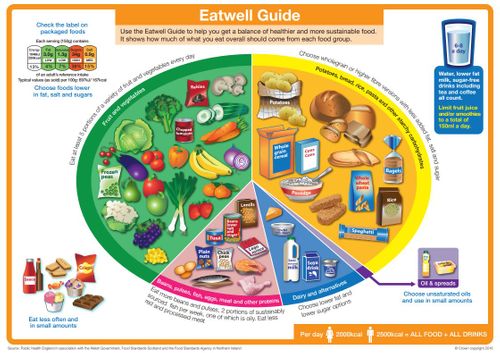
The Eatwell Guide

The Eatwell Guide shows how much of what we eat overall should come from each food group to achieve a healthy, balanced diet. You do not need to achieve this balance with every meal, but try to get the balance right over a day or even a week.

View more

Eating a balanced diet

Eating a healthy, balanced diet is an important part of maintaining good health, and can help you feel your best. This means eating a wide variety of foods in the right proportions, and consuming the right amount of food and drink to achieve and maintain a healthy body weight.

View more

Tips to eat well for less

If cost is discouraging you from trying to make changes to your and your family's diet, read on: healthy eating does not have to cost more.

View more

Meal ideas

Here are some healthy meal ideas to give you some inspiration.

View more

Healthy 100-calorie snack ideas

With these surprising 100-calorie snacks you can enjoy some of the nation's favourite treats without derailing your diet. Most of these low-calorie bites, from dietitian Azmina Govindji, require only 3 ingredients and take less than 5 minutes to prepare.

View more

Support for a healthier lifestyle

Advice, tips and tools to help you make the best choices about your health and wellbeing.

View more

Manage your weight

Being overweight can increase your risk of heart disease. Stick to a healthy, balanced diet low in fat and sugar, with plenty of fruit and vegetables, combined with regular physical activity.

Find out if you’re a healthy weight with the BMI calculator.

If you need to lose weight, you can use the NHS weight loss plan. It’s a free 12-week diet and exercise plan to help you lose weight and develop healthier habits.

Get a FREE personalized health score when you complete this 10 minute quiz.

More ways to kickstart your health

If you want to improve other aspects of your wellbeing, the NHS has many great free tools to support you:

Easy Meals app

Meal ideas, recipes, cooking tips.

Active 10 app

Track and build up your daily walks.

Drink Free Days app

For the days you do not want to drink alcohol.

Food Scanner app

Find out what’s really in your food and drink.

Couch to 5K

A running app for absolute beginners.

Featured image for The Eatwell Guide

The Eatwell Guide

The Eatwell Guide shows how much of what we eat overall should come from each food group to achieve a healthy, balanced diet. You do not need to achieve this balance with every meal, but try to get the balance right over a day or even a week.

How does the Eatwell Guide work?

The Eatwell Guide divides the foods we eat and drink into 5 main food groups.

Try to choose a variety of different foods from each of the groups to help you get the wide range of nutrients your body needs to stay healthy.

Find out how food labels can help you choose between foods and pick those lower in calories, fat, saturated fat, sugar and salt.

Combination foods

Many foods, such as pizzas, casseroles, pasta dishes and sandwiches, are combinations of the food groups in the Eatwell Guide.

With these meals, check the ingredients and think about how these fit with the sections on the guide to help you achieve a balanced diet.

Eat at least 5 portions of a variety of fruit and vegetables a day

Most of us still are not eating enough fruit and vegetables. They should make up over a third of the food we eat each day.

Aim to eat at least 5 portions of a variety of fruit and veg each day. Choose from fresh, frozen, tinned, dried or juiced.

Remember that fruit juice and smoothies should be limited to no more than a combined total of 150ml a day.

Fruit and vegetables are a good source of vitamins, minerals and fibre.

Find out more about how to get your 5 A Day

Base meals on potatoes, bread, rice, pasta or other starchy carbohydrates

Starchy food should make up just over a third of the food we eat. Choose higher fibre wholegrain varieties, such as wholewheat pasta and brown rice, or simply leave skins on potatoes.

There are also higher fibre versions of white bread and pasta.

Starchy foods are a good source of energy and the main source of a range of nutrients in our diet.

Find out more about starchy foods

Have some dairy or dairy alternatives (such as soya drinks and yoghurts)

Milk, cheese, yoghurt and fromage frais are good sources of protein and some vitamins, and they’re also an important source of calcium, which helps keep our bones healthy.

Try to go for lower-fat and lower-sugar products where possible, like 1% fat milk, reduced-fat cheese or plain low-fat yoghurt.

Find out more about milk and dairy foods

Eat some beans, pulses, fish, eggs, meat and other protein

These foods are good sources of protein, vitamins and minerals. Pulses, such as beans, peas and lentils, are good alternatives to meat because they’re lower in fat and higher in fibre and protein, too.

Choose lean cuts of meat and mince, and eat less red and processed meat like bacon, ham and sausages.

Aim for at least 2 portions of fish every week, 1 of which should be oily, such as salmon or mackerel.

Find out about fish, eggs and meat.

Choose unsaturated oils and spreads, and eat in small amounts

Unsaturated fats are healthier fats and include vegetable, rapeseed, olive and sunflower oils.

Remember all types of fat are high in energy and should be eaten sparingly.

Find out more about the different types of fat in our diet

Eat foods high in fat, salt and sugar less often and in small amounts

These foods include chocolate, cakes, biscuits, sugary soft drinks, butter, ghee and ice cream.

They’re not needed in our diet, so should be eaten less often and in smaller amounts.

Get tips on cutting down on sugar

Drink plenty of fluids – the government recommends 6 to 8 cups or glasses a day

Water, lower-fat milks and lower-sugar or sugar-free drinks, including tea and coffee, all count.

Fruit juice and smoothies also count towards your fluid consumption, but they contain free sugars that can damage teeth, so limit these drinks to a combined total of 150ml a day.

Find out more about water, drinks and your health

Download the Eatwell Guide booklet

For more information, including details of which foods are included in the food groups, download GOV.UK’s The Eatwell Guide.

Content provided by NHS.uk

Find information and advice on health conditions, symptoms, healthy living, medicines and how to get help.

Published on Thu, 02 Dec 2021 09:37:15 GMT
Modified on Mon, 04 Apr 2022 11:48:13 GMT
Featured image for Eating a balanced diet

Eating a balanced diet

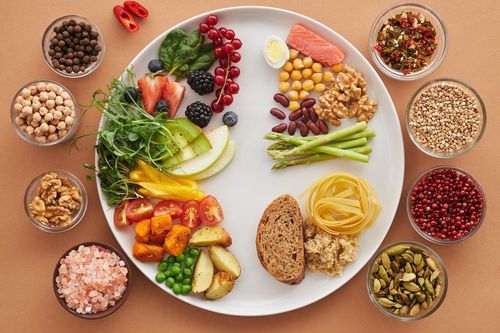
Eating a healthy, balanced diet is an important part of maintaining good health, and can help you feel your best. This means eating a wide variety of foods in the right proportions, and consuming the right amount of food and drink to achieve and maintain a healthy body weight.

Fruit and Vegetables

Fruit and vegetables are a good source of vitamins and minerals and fibre, and should make up just over a third of the food you eat each day.

It’s recommended that you eat at least 5 portions of a variety of fruit and vegetables every day. They can be fresh, frozen, canned, dried or juiced.

There’s evidence that people who eat at least 5 portions of fruit and vegetables a day have a lower risk of heart disease, stroke and some cancers.

Eating 5 portions is not as hard as it sounds.

A portion is:

  • 80g of fresh, canned or frozen fruit and vegetables
  • 30g of dried fruit – which should be kept to mealtimes
  • 150ml glass of fruit juice or smoothie – but do not have more than 1 portion a day as these drinks are sugary and can damage teeth

Just 1 apple, banana, pear or similar-sized fruit is 1 portion each.

Starchy foods and carbohydrates

Starchy foods are our main source of carbohydrate and have an important role in a healthy diet.

Starchy foods are a good source of energy and the main source of a range of nutrients in our diet. As well as starch, they contain fibre, calcium, iron and B vitamins.

Some people think starchy foods are fattening, but gram for gram they contain fewer than half the calories of fat.

Wholegrain varieties of starchy foods and potatoes (particularly when eaten with their skin on) are good sources of fibre.

Milk and dairy foods (and alternatives)

Milk and dairy foods, such as cheese and yoghurt, are good sources of protein. They also contain calcium, which helps keep your bones healthy.

The total fat content of dairy products can vary a lot. To make healthier choices, look at the nutrition information on the label to check the amount of fat, including saturated fat, salt and sugar, in the dairy products you’re choosing.

Go for lower fat and lower sugar products where possible.

Choose semi-skimmed, 1% fat or skimmed milk, as well as lower fat hard cheeses or cottage cheese, and lower fat, lower sugar yoghurt.

Dairy alternatives, such as soya drinks, are also included in this food group.

When buying alternatives, choose unsweetened, calcium-fortified versions.

Beans, pulses, fish, eggs, meat and other proteins

These foods are all good sources of protein, which is essential for the body to grow and repair itself.

They’re also good sources of a range of vitamins and minerals.

Meat is a good source of protein, vitamins and minerals, including iron, zinc and B vitamins. It’s also one of the main sources of vitamin B12.

Choose lean cuts of meat and skinless poultry whenever possible to cut down on fat. Always cook meat thoroughly.

Try to eat less red and processed meat like bacon, ham and sausages.

Eggs and fish are also good sources of protein, and contain many vitamins and minerals. Oily fish is particularly rich in omega-3 fatty acids.

Aim to eat at least 2 portions of fish a week, including 1 portion of oily fish.

Pulses, including beans, peas and lentils, are naturally very low in fat and high in fibre, protein, vitamins and minerals.

Nuts are high in fibre, and unsalted nuts make a good snack. But they do still contain high levels of fat, so eat them in moderation.

Oils and spreads

Some fat in the diet is essential, but on average people in the UK eat too much saturated fat.

It’s important to get most of your fat from unsaturated oils and spreads.

Swapping to unsaturated fats can help lower cholesterol.

Remember that all types of fat are high in energy and should be eaten in small amounts.

Saturated fat, sugar and salt

Fat is a source of essential fatty acids, which the body cannot make itself.

Saturated fats are found in many foods, both sweet and savoury.

Most of them come from animal sources, including meat and dairy products, as well as some plant foods, such as palm oil and coconut oil.

As part of a healthy diet, you should try to cut down on foods and drinks that are high in saturated fats and trans fats and replace some of them with unsaturated fats.

Too much saturated fat can increase the amount of cholesterol in the blood, which increases your risk of developing heart disease.

Regularly consuming foods and drinks high in sugar increases your risk of obesity and tooth decay.

Eating too much salt can raise your blood pressure, which increases your risk of getting heart disease or having a stroke.

Adults and children aged 11 and over should eat no more than 6g of salt (about a teaspoonful) a day. Younger children should have even less.

Content provided by NHS.uk

Find information and advice on health conditions, symptoms, healthy living, medicines and how to get help.

Published on Mon, 17 Jan 2022 14:43:35 GMT
Modified on Mon, 11 Apr 2022 15:49:19 GMT
Featured image for Tips to eat well for less

Tips to eat well for less

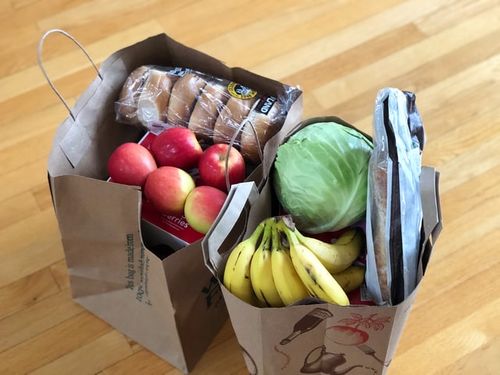
If cost is discouraging you from trying to make changes to your and your family's diet, read on: healthy eating does not have to cost more.

Write a shopping list

Draw up a weekly meal plan using up ingredients you already have and make a shopping list of any missing items.

Try not to shop when hungry. People who shop when hungry are more likely to spend more, especially on less healthy foods, such as high-fat and sugary snacks.

Waste nothing

The average family with children throws away almost £60 of good food every month. Be strict about buying only what you’ll actually eat.

Plan your meals so all the ingredients on your list get used. Freeze any unused food. Food storage bags and boxes will come in handy.

Eat leftovers for lunch

Cook extra portions for your evening meal so you can have the leftovers for lunch the next day.

Any leftovers can be frozen for another day. Eventually, you’ll have a freezer full of homemade ready meals on tap.

Find out how to use leftovers safely

Buy frozen

Frozen fruit and vegetables are underrated. They come pre-chopped and ready to use, are just as good for you (try to avoid those with added salt, sugar or fat), and are often cheaper than fresh varieties.

Frozen vegetables are picked at the peak of freshness and then frozen to seal in their nutrients.

Get tips on freezing and defrosting

Try cheaper brands

You could save money by buying cheaper brands than you normally do.

There’s not always much difference between value and premium ranges. Give it a go and let your taste buds be the judge, not the shiny label.

Find out how food labels can help you make healthier choices

Eat more veg

Meat and fish are typically the most expensive food ingredients on a shopping list.

How about adding vegetables to meat dishes like casseroles to make your meals go further? Or try a few vegetarian meals during the week to keep costs down.

Make it fun by joining the thousands of people who regularly take part in meat-free Monday.

Cook with pulses

Pulses, such as beans, lentils and peas, are some of the cheapest foods on the supermarket shelf.

These pulses are low in calories and fat but packed with fibre, vitamins and minerals, and also count towards your 5 A Day.

Use them in dishes to replace some of the chicken or meat, such as a chilli con carne with kidney beans or a chicken curry with chickpeas.

Freeze leftover bread

Bread is one of the most wasted household foods. Reduce waste by freezing bread, preferably in portions (for convenience) and when it’s at its freshest (for taste).

Store bread in an airtight container (such as a freezer bag) to avoid freezer burn.

Know your kitchen

Know what’s in your kitchen store cupboard, fridge and freezer. You may find you have got enough ingredients to make a meal.

Plan your week’s meals to include ingredients you have already got in and avoid buying items you already have.

Check use-by dates to make sure you use up ingredients before they go off.

Buy cheaper cuts

If you’re prepared to take a little more time with your cooking, buying cheaper cuts of meat is a great way to save money.

Choosing a cheaper cut of meat, such as braising steak, shin or shoulder, does not mean missing out on a tasty meal.

Slow cooking gradually breaks down the fibres in cheaper cuts, giving great taste at a lower cost.

Look up cheap recipes

Cheap does not have to mean less tasty. There are plenty of websites offering recipes for cheap eats and leftover ingredients.

Check out Change4Life’s healthy recipes for some inspiration and easy meal ideas.

Eat smaller portions

Try eating smaller portions by saying no to a second helping or using smaller plates.

You’ll have more left over for lunch the next day and your waistline may benefit, too.

Try weighing or measuring out staples such as pasta and rice when cooking to stay in control of portion size and reduce waste.

Cook from scratch

Save money by cutting back on takeaways. Preparing and cooking your own meals is generally cheaper than buying a takeaway or a ready meal, and because it’s easier to control what goes into your dish, it can be healthier.

Buy chicken whole

The cheapest way to buy chicken is to buy a whole chicken. From a whole chicken, you’ll get 2 breasts, 2 thighs, drumsticks and wings, plus a carcass for making stock.

Consider using the deli counter for cheese and cured meats. You can get exact amounts, which is cheaper and less wasteful.

Compare pre-packed with loose

Fruit and vegetables sometimes cost more pre-packed than loose.

Check the price per weight (for example, £/kg). Stores know that consumers want to buy in bulk, so they mix it up: sometimes the packed produce is cheaper, sometimes it’s more expensive.

Also, pre-packed is not always the freshest and you may end up with more than you need.

Cut down on luxuries

If your regular shopping basket tends to include fizzy drinks, crisps, snack bars, biscuits and cakes, try trimming down on these non-essential items.

Many of these are high in sugar and fat, so you’ll be doing your waistline and your bottom line a favour. They can also contain a lot of salt.

Think about cheaper and healthier alternatives, such as sparkling water and fruit juice instead of cola, or fruit and plain yoghurt.

Beware of BOGOF offers

Special discounts, such as buy-one-get-one-free (BOGOF) deals, can offer good value, but be careful.

Only buy items you actually need and are likely to keep and use. Tinned or frozen fruit and veg, or rice and pasta, are good examples.

Markdowns on perishables at the end of the shopping day are another way to bag a saving.

But make sure the item gets used before the use-by date and does not go off sooner than expected.

Toddlers eat the same

If you have a toddler in tow, get them used to eating the same meals as you instead of relying on costly pre-prepared toddler food.

Simply blend or chop up their portion to suit their age and freeze extra child-sized portions for later.

Make sure not to add any salt to their portions, and be careful with spicy food.

Shop online

Search for supermarket price comparisons that let you select a basket of products and then choose the cheapest supplier. The price differences can be significant.

Unlike going to the shops yourself, you’ll know how much you have spent before going to the till, which can make it easier to stay within budget.

Shop during the ‘happy hour’

Most supermarkets discount fresh items towards the end of the day.

But with longer opening hours, it’s a case of finding out just the right time to grab those bargains.

If you time it right, the “reduced to clear shelves” can save you big money. Always check use-by dates.

Content provided by NHS.uk

Find information and advice on health conditions, symptoms, healthy living, medicines and how to get help.

Published on Mon, 17 Jan 2022 16:10:38 GMT
Modified on Tue, 10 May 2022 15:33:14 GMT

Featured image for Meal ideas

Meal ideas

Here are some healthy meal ideas to give you some inspiration.

Breakfast ideas:

Lunch ideas:

Dinner ideas:

More suggestions:

Eating Well

Healthy, delicious recipes, including quick dinner, easy lunch ideas, snacks, breakfast, soup and more, from the food and nutrition experts at EatingWell.

Change For Life

Get the family involved and make tasty meals from scratch.

Content provided by NHS.uk

Find information and advice on health conditions, symptoms, healthy living, medicines and how to get help.

Published on Thu, 02 Dec 2021 09:35:57 GMT
Modified on Mon, 04 Apr 2022 11:49:57 GMT

Featured image for Healthy 100-calorie snack ideas

Healthy 100-calorie snack ideas

With these surprising 100-calorie snacks you can enjoy some of the nation's favourite treats without derailing your diet. Most of these low-calorie bites, from dietitian Azmina Govindji, require only 3 ingredients and take less than 5 minutes to prepare.

Cheese and tomato toastie (93kcal)

A slimmed-down but no less scrumptious version of an all-time British classic. Simply chop the tomato and spring onion, sprinkle them over a slice of crispbread, cover with grated cheese and place under a pre-heated grill for a couple of minutes.

  • 1 wholegrain crispbread: 39kcal
  • 15g grated 30%-less-fat mature cheese: 47kcal
  • 40g tomato: 7kcal
  • an optional sprinkling of chopped spring onion (calories nominal)

‘3-fruit’ fruit salad (102kcal)

Refreshing and easy to make, this “3-fruit” fruit salad, which includes store-cupboard-friendly tinned pineapple, provides 2.5 portions of your recommended 5 A Day.

  • 50g seedless black grapes, cut in half: 30kcal
  • 50g diced apple: 26kcal
  • 100g chopped tinned pineapple in juice: 46kcal

Cheese and pickle canapés (100kcal)

Enjoy these party nibbles without breaking the calorie bank. Use a potato peeler to get melt-in-your-mouth, wafer-thin cheese slices, and top with gherkin slices and pickle.

  • 3 water biscuits: 42kcal
  • 15g 30%-less-fat mature cheddar: 46kcal
  • 30g gherkin: 4kcal
  • 6g (1tsp) pickle: 8kcal

Smoked salmon and cream cheese parcels (109kcal)

For a touch of sophistication, try these delicate smoked salmon parcels. To prepare, place 4 strips of salmon on an even surface and spread 5g of soft cheese mixed with some dill at one end of each strip. Starting from the cheese end, gently fold each strip into rolls.

  • 48g smoked salmon, cut into 4 even strips: 68kcal
  • 20g reduced-fat soft cheese (5g per parcel): 39kcal
  • a squeeze of lemon juice: 2kcal
  • optional sprinkling of fresh dill

Apple and peanut butter (96kcal)

Craving something crunchy and nutty? Fresh apple slices and peanut butter are the perfect combination to keep you going until your next main meal.

  • 50g sliced apple: 26kcal
  • 12g (1tsp) peanut butter: 70kcal
  • optional sprinkling of cinnamon

Baked beans on toast (99kcal)

It’s perhaps the ultimate comfort food, and we believe you should still be able to enjoy it even if you’re watching your calories.

  • a 22g slice of toasted wholegrain or wholemeal bread: 48kcal
  • 60g baked beans: 51kcal
  • optional sprinkling of chives

Homemade popcorn (89kcal)

The smell of freshly made popcorn is right up there with freshly baked bread. As a source of fibre, popcorn will keep you feeling full for longer, making it an ideal snack – plus, it’s really easy to make.

  • 20g popping corn: 62kcal
  • 3g (1tsp) of vegetable oil: 27kcal
  • optional sprinkling of chilli powder and worcester sauce

Content provided by NHS.uk

Find information and advice on health conditions, symptoms, healthy living, medicines and how to get help.

Published on Mon, 17 Jan 2022 15:35:24 GMT
Modified on Tue, 10 May 2022 15:34:25 GMT

 

Featured image for Support for a healthier lifestyle

Support for a healthier lifestyle

Advice, tips and tools to help you make the best choices about your health and wellbeing.

Lifestyle advice:

  • Stop smoking – Local stop smoking services are free, friendly and can massively boost your chances of quitting for good.
  • Alcohol support – Realising you have a problem with alcohol is the first big step to getting help.

Exercise help:

Local support:

alexandra rose charity logo and link to website

Alexandra Rose

The Rose Vouchers for Fruit & Veg Project helps families on low incomes to buy fresh fruit and vegetables and supports them to give their children the healthiest possible start.

live your life well logo and link to website

Live Your Life Well

Making small changes to your life can have a massive impact on the way you feel. During the Coronavirus (COVID-19) outbreak you may feel anxious, stressed or worried. There are things you can do to help you feel better.

feeding liverpool logo and link to website

Feeding Liverpool

Find a community Food Space near you

liverpool local council logo and link to foodbanks website

Local Foodbanks

Your local foodbank can provide at least three days’ emergency food and support to people in crisis.

To find out more about Feeding Liverpool and the ‘Good Food Plan,’ click here.

Eating Disorders:

Content provided by NHS.uk

Find information and advice on health conditions, symptoms, healthy living, medicines and how to get help.

Published on Fri, 03 Dec 2021 09:40:42 GMT
Modified on Mon, 04 Apr 2022 11:51:54 GMT

Content provided by NHS.uk

Find information and advice on health conditions, symptoms, healthy living, medicines and how to get help.

Published on Thu, 02 Dec 2021 09:32:51 GMT
Modified on Fri, 23 Jun 2023 10:15:15 GMT

Eating well on a budget

Featured image for Eating well on a budget

Eating well on a budget

Healthy eating is important and doesn’t need to be expensive. This food fact sheet will give you some ideas to help you to eat well and keep costs down.

Top tips to save money when shopping

Follow these tips when you go shopping to help you spend less:

  1. Make a meal plan, particularly for your main meals.
  2. Write a shopping list and check what food you already have at home to avoid buying things you don’t need.
  3. Select a time to shop in the week when you are not in a rush.
  4. If you can, avoid shopping on an empty stomach as it may affect what and how much you buy. Consider shopping after you have eaten.
  5. Be aware that special offers are not always the cheapest option (See ‘How to read a label’).
  6. Ask a member of staff at your supermarket for fresh food reduction times and try to shop then. for reduced priced items. Avoid purchasing more than you need or can store. Use within the specified date or freeze for later.
  7. Value brands often taste just as good for a lower price.
  8. Local food markets offer locally-sourced foods which are usually good value for money.
  9. Cheaper products are not always at eye level or positioned obviously. Check out all the shelves (including top and bottom).
  10. Larger supermarkets offer a better range of produce, often at a cheaper cost, so do your main shop there if you can.

5-a-day on a budget

  • Select seasonal fruits and vegetables as they are widely available and less expensive, for example strawberries in summer and parsnips in winter. Find out more here.
  • Consider loose produce, for example loose apples are often cheaper than the packaged variety (See ‘How to read a label’).
  • Some supermarkets sell ‘wonky’ fruit and vegetables which are just as nutritious but vary in shape and size – so cost less.
  • Tinned fruits and vegetables are cheap and quick options to add to meals. For example, a portion of baked beans is one of your 5-a-day and a source of protein. For a healthier choice choose fruit canned in natural juice rather than syrup and vegetables canned in water without added salt.
  • Frozen fruits and vegetables can be good value and highly nutritious as the nutrients are sealed in during the freezing process. They are also pre-prepared which makes cooking quicker and easier. Try adding some to your meals, for example, add berries to your porridge or peas to your rice.
  • A small, cupped handful (30g) of dried fruit is a portion and can be added to your cereal or salad, for example raisins or apricots.
  • Visit a local allotment or community garden as they may have cheap fruits and vegetables for sale.

Cooking tips and reducing food waste

Cooking from scratch can be cheap, fun and builds your confidence! Follow these tips below:

  • Make your favourite takeaway food at home, for example curry and rice or stir fry with noodles.
  • Make homemade soups from left over vegetables.
  • Leave fruit and vegetable skins on wherever possible and suitable. If peeling is required, some peelings can be added to recipes like soups or stews.
  • Reduce your meat portions and consider having a meat free meal or day at least once per week. Replace protein sources with alternatives, for example, add chickpeas to curry or baked beans to shepherd’s pie.
  • Good value protein sources include: baked beans, tinned mixed beans, tinned chickpeas, lentils, some meat substitutes, milk, yoghurt, hummus, hens’ eggs, frozen chicken thighs, budget cuts of meat, tinned fish (especially sardines and mackerel) or frozen fish.
  • Prepare a homemade packed lunch, for example leftovers from the night before or a sandwich.
  • Have a stock of herbs and spices to add flavour to meals or side dishes. Mixed herbs are good to add to most savoury dishes.
  • Freeze excess food, such as bread and other perishables. Most foods can be frozen, so look at the packaging for guidance.
  • Consider bulk or batch cooking meals if you can (make a large amount and split into portions). Freeze or refrigerate leftovers for convenience and to save money.

Help for struggling income families

Content provided by The British Dietetic Association (BDA)

The British Dietetic Association (BDA) is the only body in the UK representing the whole of the dietetic workforce.

Published on Wed, 01 Dec 2021 10:13:30 GMT
Modified on Thu, 31 Mar 2022 14:54:39 GMT

Healthy Snacks

Featured image for Healthy Snacks

Healthy Snacks

The key to whether snacking is good or bad for you is which snacks you choose, and how much of them you eat. If you choose carefully and plan ahead, snacks can be a healthy part of your diet.

Snacks provide energy for your activities through the day and they can provide valuable nutrients such as vitamins, minerals, protein and fibre. They may also stop you overeating at the next meal by preventing you from becoming too hungry.

On the downside, some snack foods can be a source of extra fat, sugar and salt, so choose carefully and keep portion sizes sensible.

Focus on the food groups

Choose snacks from the four main food groups, try to vary which group throughout the week and if you are watching your weight limit your choices from the carbohydrate section.

Fruit and Vegetables

Many of these foods are perfectly packaged for snacking, at home or on the go and will help you reach the recommended target of 5-a-day, for example bananas, satsumas, apples or grapes. If you have a bit more time, you could try:

  • carrot, cucumber or celery sticks with cottage cheese or hummus
  • chopped melon or pineapple (tinned or fresh)
  • frozen grapes or frozen pineapple slices.

Carbohydrates – bread, rice, potatoes, pasta and other cereals

These foods fuel our body throughout the day. They are low in fat, and contain even more fibre and minerals if you choose wholegrain types.

Try these easy snack suggestions:

  • plain or fruit scone
  • small bowl of wholegrain cereal with semi-skimmed milk
  • a half sandwich or slice of toast with sliced banana and a little honey or thinly spread nut butter
  • small bag of rice cakes, or two large ones
  • half a bagel with low-fat cheese spread
  • small bag of plain or lightly salted popcorn
  • a hot-cross bun or slice of malt loaf

Protein – meat, fish, eggs and beans

Most of us eat enough of these foods at meals to meet our needs, but there are also some good options for snacks. And because foods from this group are high in protein, they may also help to keep us fuller. Here are a few ideas:

  • a small handful of nuts
  • a boiled egg
  • a tablespoon of nut and seed mix on top of low-fat yoghurt
  • hummus (look for lower-fat versions) with carrot, cucumber and celery sticks
  • slices of apple spread with nut butter

Milk and dairy

Many of us don’t get enough calcium in our diet. Snacking on these calcium rich foods can help you to reach your recommended two to three servings of dairy foods each day:

  • low-fat yoghurt or fromage frais (preferably unsweetened)
  • low-calorie hot chocolate made with semi-skimmed milk
  • cottage cheese and plain crackers
  • fruit smoothie made with semi-skimmed milk

What about crisps, chocolates and sweets?

The fifth food group is made up of foods that are high in fat and sugar and includes foods such as crisps, biscuits, chocolate and sweets. It’s fine to have a small amount of these foods occasionally; the important thing is to get the overall balance right.

If you can’t resist, try smaller portions like small bags of crisps, or fun-sized chocolate bars/bags of sweets and save them for an occasional treat. If you are unsure whether a snack you are choosing is an everyday or an occasional food, check out the food label and follow the ‘snack attack’ strategies below.

More tips:

  • Try to snack because you’re hungry, because it’s a long time between meals, or because you’re planning an exercise session – not just because the food is there.
  • Try having a drink first – we often mistake hunger for being thirsty, so have a large glass of water and if you are still hungry after ten minutes, then have a snack as well.
  • It can be easiest to start by focusing on just one ‘danger’ time of the day, say mid-afternoon or evening snacks and try one of these strategies out!

Often it’s not just a matter of knowing what choices are better – If you’re really hungry and there are no healthy snacks around, it’s very easy to eat something unhealthy instead. Make nutritious snacking easier with the following strategies:

  • At work – keep healthy snacks at your desk or in the office refrigerator. Bring a bag of fresh fruit to work each week or keep a stash of rice crackers in the desk drawer.
  • On the go – if you’re going to be out and about, take a healthy snack in your bag. An apple, rice cakes or a small bag of nuts or raisins are very portable.
  • In the shops – try to avoid buying less nutritious snacks such as crisps and biscuits, so you don’t have them tempting you while at home.
  • At home – have a bowl of fruit on display on the kitchen counter and reduced-fat and sugar yogurts in the front of the fridge and cut up sticks of vegetables, so you notice the healthy options. Keep less healthy treats out of sight.

Content provided by The British Dietetic Association (BDA)

The British Dietetic Association (BDA) is the only body in the UK representing the whole of the dietetic workforce.

Published on Wed, 01 Dec 2021 09:57:55 GMT

Modified on Thu, 31 Mar 2022 14:52:47 GMT

Getting the right balance

Featured image for Getting the right balance

Getting the right balance

Healthy eating is about having a balance of different foods and nutrients in the diet for good health and wellbeing. It is not about ‘dieting’. It doesn’t have to be boring or difficult. Healthy eating is about enjoying your food, at the same time as being mindful about what you eat.

Carbohydrates

Carbohydrate (starch) is the body’s main energy (fuel) source. Starch is broken down to produce glucose which is used by the body for energy. 

Starchy foods are an important part of the diet. They should make up about a third of all the food that we eat. You don’t have to avoid or restrict them because they are ‘fattening’. Instead, be aware of the total amount of starch that you eat. Cutting out one food group, such as carbohydrate can cause dietary imbalance. Starchy foods include bread, potatoes, rice and pasta. Wholegrain options are healthier choices.

Fruit and Vegetables

Fruit and vegetables contain high levels of ‘micronutrients’. These include vitamins, minerals and antioxidants. Micronutrients are essential to the body’s many biochemical processes.

Fruit and vegetables are often high in fibre. They are generally low in calorie and they taste good!

The current UK guidance recommends at least five portions of different fruit and veg per day. Like carbohydrate, fruit and veg should account for about one third of what we eat, per day. Dried, frozen, tinned, as well as fresh, fruit and veg are all included. One portion of pulses (baked beans, lentils, dried peas) can also count towards your five a day. 

Protein

Protein is vital. It is the body’s main building block. Animal products such as meat, fish, eggs and dairy are good sources of dietary protein. Meat and fish also provide the body with a form of iron (haem), which is easy to absorb. Fish also contains essential fatty acids (eg. omega-3).

Protein also comes from foods of plant origin. Pulses, nuts, and seeds are all high in protein. Pulses are a very good meat alternative, whether or not you are vegetarian or vegan.

Cutting back on consumption of red meat (beef, lamb, goat, pork) especially, is better for your health and for the environment: current advice is to have no more than 300g of red meat per week. Try to avoid processed meats such as bacon, salami, hot dogs, ham. Consumption of these cured meat products has been linked to a much higher risk of certain gut cancers. 

Dairy

Dairy products (and calcium-fortified alternatives) are the body’s main source of calcium, which is necessary for the growth, development and maintenance of healthy bones and teeth. Dairy products and alternatives are also a source of protein.

Milk, cheese, cream and milk-based sauces and yoghurts can have a high saturated fat content. Fat reduced options are recommended, and small quantities.

Fats

Dietary fats have many important functions in the body. Like carbohydrate, fat provides energy or fuel (measured in calories) but is more calorie-dense (calorific) in comparison. All fats should be consumed in small quantities. All fats have the same calorie content, but they have different effects on the body, and especially, on cholesterol levels.

Saturated fats

Saturated fats can increase the level of a certain type of cholesterol, (LDL) which can build up, over time, in the arteries and blood vessels, leading to heart disease and other problems of the circulatory system.

Saturated fats are often found in high levels in fatty meat, butter, cheese, cream and in many processed foods (though not eggs or shellfish). Trans saturated (or hydrogenated) fats are another type of saturated fat. They are mainly, artificially produced and used in food manufacture.  

Try to limit your intake of all saturated fats – check food labels for details. Learn more about food labelling.

Unsaturated Fats

Unsaturated oils and spreads are the best choice of dietary fat. These are found in many vegetable oils and include olive oil, rapeseed nut and seed oils. All contain ‘good’ HDL cholesterol, which can remove the potentially harmful LDL cholesterol (found in saturated fats) from the body.  

Essential Fatty Acids (EFAs)

EFAs (such as omega-3 oils) are ‘essential’ because our bodies can’t make them and we have to obtain them from our food. EFAs are found in the skin of white fish but also in the flesh of oily fish such as fresh and tinned salmon, mackerel, sardines and fresh tuna. Advice for fish eaters is to have one portion of oily fish, and one portion of white fish per week.

EFAs can also be found in some plant oils such as flaxseed, rapeseed and soya but there is not as much in these oils as there is in fish and seafood.

Sugar

Sugar is a type of carbohydrate. Like starch, it breaks down into glucose, to provide energy for the body. ‘Free’ sugars are often added to foods during manufacture and include refined sugars such as sucrose (table sugar). This kind of sugar is also found naturally, in unsweetened fruit juices, and in syrups and honey.   

Excess consumption of free sugars is linked to the risk of obesity, type 2 diabetes and tooth decay. Many of the free sugars that we consume, are in sugary drinks. A regular can of cola for instance, can contain the equivalent of seven teaspoons of sugar (35g). The guidance about free sugar consumption suggests a daily limit of 30g. This is equivalent to six teaspoons.

The natural sugars found in milk and in whole fruits and vegetables are not free sugars and do not need to be restricted in the same way. 

Salt

High levels of salt in the diet can increase blood pressure. Most of the salt that we eat is added to processed foods. The total daily salt intake for adults should be no more than 6g per day (one tsp).

Content provided by The British Dietetic Association (BDA)

The British Dietetic Association (BDA) is the only body in the UK representing the whole of the dietetic workforce.

Published on Wed, 01 Dec 2021 09:47:06 GMT

Modified on Mon, 07 Mar 2022 09:27:39 GMT
Checking your breasts

Featured image for Checking your breasts

Checking your breasts

There's no right or wrong way to check your breasts. But it's important to know how your breasts usually look and feel. That way, you can spot any changes quickly and report them to a GP.

Be breast aware

Every woman’s breasts are different in terms of size, shape and consistency. It’s also possible for one breast to be larger than the other.

Get used to how your breasts feel at different times of the month. This can change during your menstrual cycle. For example, some women have tender and lumpy breasts, especially near the armpit, around the time of their period.

After the menopause, normal breasts feel softer, less firm and not as lumpy.

The NHS Breast Screening Programme has produced a 5-point plan for being breast aware:

  • know what’s normal for you
  • look at your breasts and feel them
  • know what changes to look for
  • report any changes to a GP without delay
  • attend routine screening if you’re aged 50 to 70

Look at your breasts and feel each breast and armpit, and up to your collarbone. You may find it easiest to do this in the shower or bath, by running a soapy hand over each breast and up under each armpit.

You can also look at your breasts in the mirror. Look with your arms by your side and also with them raised.

Breast changes to look out for

See a GP if you notice any of the following changes:

  • a change in the size, outline or shape of your breast
  • a change in the look or feel of the skin on your breast, such as puckering or dimpling, a rash or redness
  • a new lump, swelling, thickening or bumpy area in one breast or armpit that was not there before
  • a discharge of fluid from either of your nipples
  • any change in nipple position, such as your nipple being pulled in or pointing differently
  • a rash (like eczema), crusting, scaly or itchy skin or redness on or around your nipple
  • any discomfort or pain in one breast, particularly if it’s a new pain and does not go away (although pain is only a symptom of breast cancer in rare cases)
Always see a GP if you are concerned

Breast changes can happen for many reasons, and most of them are not serious. Lots of women have breast lumps, and most breast lumps are not cancerous.

However, if you find changes in your breast that are not normal for you, it’s best to see a GP as soon as possible. This is because it’s important to rule out breast cancer. If cancer is detected, then appropriate treatment should be planned as quickly as possible.

Find out more information about cancer.

Videos

More support

Breast screening (mammogram)

Information from the NHS on breast screening, who is invited and what happens at your appointment.

Sign up for monthly reminders

Wherever and whenever you like to coppafeel, we have all you need to make sure you remember to get hands on with your boobs each month.

Information on breast cancer form Macmillan

Find information about all types of cancer, including diagnosis, treatments and drugs, as well as advice to help with the different ways cancer may impact your life.

>

Content provided by NHS.uk

Find information and advice on health conditions, symptoms, healthy living, medicines and how to get help.

Published on Fri, 26 Nov 2021 15:29:03 GMT
Modified on Wed, 09 Feb 2022 16:44:44 GMT

24 Magic Months – free app for parents and carers

Featured image for 24 Magic Months - free app for parents and carers

24 Magic Months – free app for parents and carers

The first two years of your baby’s life are the most important for their growth and development.

The 24 Magic Months app was created to guide parents and carers through this time with trusted and consistent advice from healthcare professionals and parents, helping parents to keep up to date with what to expect at each stage of a child’s development.

The app was created by Liverpool City Council’s Public Health Team and it will help parents and carers to make magic moments and mark every incredible milestone.

24 Magic Months is free to download from the App and Play stores.

24 Magic Months includes quick and simple activities that help babies develop their speech, brain and social skills, as well as encouraging a close relationship between mums and dads and their children.

The advice in the app covers the following topics:

  • Social and emotional development
  • Physical development
  • Learning and play
  • Speech and language development
  • Feeding
  • Bonding and attachment
  • Behaviour
  • Sleep
  • Parental health and wellbeing
  • Local support

Features

Personalised, reliable advice about child development

The information available in the 24 Magic Months app was developed with healthcare professionals and local parents so the information is reliable and up to date. Articles cover a variety of focused topics such as language development or sleep, simple tips, as well as general information about the how a child grows.

All information is accessible at all times so that curious parents can find out more about which developmental milestones are coming up for their little one over the coming months.

Children profiles

24 Magic Months allows parents to add multiple children up to the age of 2 years and provides child development information that is relevant to that child’s profile.

Developmental milestone tracker

Developmental milestones allow parents to monitor a child’s development by recording when each milestone is reached. Any milestones that the child achieves are saved onto the App, which is designed to help parents to record and easily evidence their child’s progress.

Videos from local healthcare professionals

24 Magic Months includes a range of videos from healthcare professionals on important topics like sleep, dummies and introducing solid foods.

Local support

24 Magic Months offer information about local support including videos explaining the help available from health visitors and children’s centres, and contact details for health professionals.

Tips and advice from within the app:

Be in the moment

Try to find time during your day where you play and talk to your baby without distraction from your phone or TV. Talking with your baby without distractions and having lots of eye contact is good for your baby’s brain development and for growing a close relationship between you.

You cannot show your baby too much affection

It’s a myth that babies can have too much attention. Your baby needs lots of love and affection from you and other family members to help them feel secure, build confidence and stimulate the brain.

Play and story time

Play and story time are great ways to build a bond with your baby as well as develop their speech and language skills. It doesn’t matter that your little one is too young to understand stories yet, your baby loves the sound of voices and could be beginning to pick out the sounds of separate words.

Content provided by 24 Magic Months.

Published on Wed, 27 Oct 2021 11:39:14 GMT
Modified on Thu, 28 Oct 2021 14:35:09 GMT